
HL7 Training: What It Is, Why It Matters
Healthcare systems generate massive amounts of patient data every day. Hospitals, laboratories, pharmacies, and insurance systems all need to exchange this information quickly and accurately. However, different healthcare applications often use different technologies and data formats, which makes communication between systems difficult.
This is where HL7 (Health Level Seven) comes in.
HL7 is a widely used standard that enables healthcare systems to exchange patient information in a structured and reliable way. Because of its importance in modern healthcare IT infrastructure, HL7 training has become a valuable skill for professionals entering the healthcare technology industry.
In this article, we will explore what HL7 training is, why HL7 is used in healthcare systems, the benefits of learning HL7, and how HL7 training can help build a strong career in healthcare IT.
What Is HL7?
HL7 stands for Health Level Seven, which refers to the seventh layer of the OSI (Open Systems Interconnection) model—the application layer where healthcare applications communicate with each other.
HL7 is not a software tool or programming language. Instead, it is a set of standards that define how healthcare information should be structured and exchanged between systems.
For example, when a patient is admitted to a hospital, multiple systems may need to receive that information, including:
- Electronic Health Record (EHR) systems
- Laboratory information systems
- Billing and insurance systems
- Pharmacy management systems
- Radiology systems
HL7 ensures that these systems can exchange information efficiently, even if they are developed by different vendors.
What Is HL7 Training?
HL7 training is a specialized educational program designed to teach individuals how healthcare systems exchange information using HL7 standards.
This training typically focuses on the technical concepts behind HL7 messaging, system integration, and interoperability in healthcare environments.
HL7 training helps learners understand:
- How healthcare systems communicate with each other
- How HL7 messages are structured
- How patient data flows between systems
- How to troubleshoot and manage HL7 interfaces
The training is especially valuable for individuals who want to work in healthcare IT integration, interoperability, and clinical data exchange.
Key Components Covered in HL7 Training
A good HL7 training program usually introduces several important concepts that form the foundation of healthcare data exchange.
1. HL7 Message Structure
HL7 messages follow a structured format that allows systems to interpret patient data correctly. Messages are divided into segments, and each segment contains multiple fields separated by special characters called delimiters.
Common segments include:
- MSH (Message Header) – contains information about the sender, receiver, and message type
- PID (Patient Identification) – contains patient demographic information
- PV1 (Patient Visit) – contains visit-related information
- OBR (Observation Request) – contains lab test orders
- OBX (Observation Result) – contains clinical results
Understanding message structure is one of the first skills taught in HL7 training.
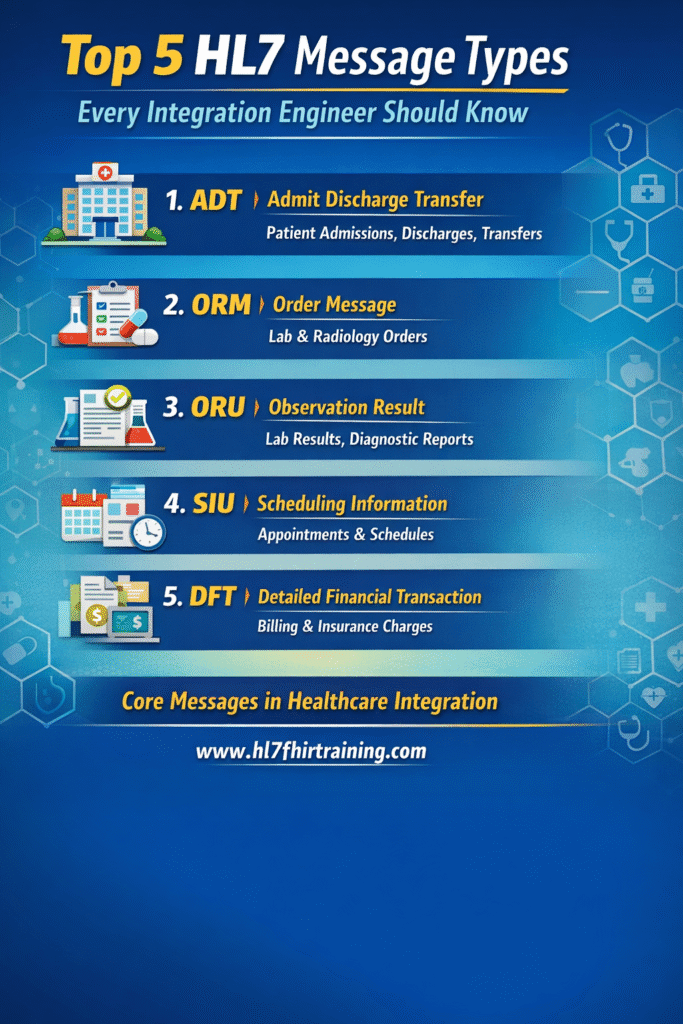
2. HL7 Message Types
HL7 messages are generated when certain events occur in a healthcare system. These are known as trigger events.
Common HL7 message types include:
- ADT (Admission, Discharge, Transfer) – patient movement within the hospital
- ORM (Order Message) – used when a physician orders lab tests or procedures
- ORU (Observation Result) – used to send laboratory or diagnostic results
HL7 training teaches learners how these messages are triggered and how they move between systems.
3. Healthcare System Integration
One of the main goals of HL7 is system interoperability. Hospitals often use multiple software systems that must work together seamlessly.
HL7 training explains how different healthcare systems connect and exchange data using interfaces.
For example:
- A patient is admitted into the hospital system.
- An ADT message is generated.
- The message is sent to the laboratory, billing, and pharmacy systems.
- Each system updates its records with the patient information.
This process ensures accurate and synchronized patient data across the entire hospital environment.
Why Is HL7 Used in Healthcare?
HL7 plays a critical role in healthcare because it enables systems to share patient information efficiently and securely.
Below are some of the main reasons HL7 is widely used in healthcare environments.
1. Interoperability Between Systems
Healthcare organizations often use systems from different vendors. Without a common standard, these systems would struggle to communicate.
HL7 provides a standardized format that allows different systems to exchange data reliably.
This interoperability is essential for modern healthcare operations.
2. Improved Patient Care
Accurate and timely information is critical for patient care. HL7 ensures that patient data is available to the right system at the right time.
For example:
- Doctors can access lab results quickly
- Pharmacists can verify medication orders
- Billing departments receive correct patient information
This helps healthcare providers make faster and better decisions.
3. Efficient Workflow in Hospitals
Hospitals handle thousands of patient interactions daily. HL7 helps automate many of these workflows.
For example:
- When a patient is admitted, information automatically reaches all relevant systems.
- When lab results are ready, they are automatically sent to the physician’s system.
This reduces manual work and improves operational efficiency.
4. Standardized Data Exchange
Without standards, each healthcare system would use its own format for data exchange. This would create confusion and errors.
HL7 ensures that data is structured in a consistent format that systems can interpret correctly.
Real-World Uses of HL7
HL7 is used in a wide range of healthcare scenarios. Some common real-world applications include:
Hospital Information Systems
Hospitals rely on HL7 to coordinate patient data across departments such as registration, billing, laboratory, and radiology.
Laboratory Systems
When a physician orders a test, an ORM message is sent to the lab system. After the test is completed, an ORU message returns the results to the hospital system.
Radiology Systems
Imaging results such as X-rays or MRIs can be transmitted using HL7 messages to ensure physicians receive diagnostic data quickly.
Pharmacy Systems
Medication orders and prescription details can be shared between hospital systems and pharmacy management systems.
Who Should Learn HL7?
HL7 training is useful for a variety of professionals who work in healthcare technology or data integration.
Typical learners include:
- Healthcare IT professionals
- Software developers working in healthcare systems
- System integration engineers
- Data analysts in healthcare environments
- Health informatics professionals
Even individuals with a general IT background can transition into healthcare IT by learning HL7.
Career Opportunities After HL7 Training
As healthcare organizations continue to digitize their operations, the demand for professionals who understand healthcare interoperability is growing.
Some common job roles include:
HL7 Interface Developer
These professionals design and manage HL7 interfaces that allow healthcare systems to exchange data.
Integration Engineer
Integration engineers connect different healthcare systems and ensure smooth communication between them.
Healthcare IT Analyst
These analysts work with clinical systems and help organizations optimize their data workflows.
Interoperability Specialist
Specialists focus on ensuring that healthcare systems can exchange data using standards like HL7 and FHIR.
Benefits of Learning HL7
HL7 training offers several advantages for individuals interested in healthcare technology careers.
High Industry Demand
Healthcare organizations around the world rely on HL7 for system communication. As a result, professionals with HL7 knowledge are in demand.
Specialized Skill Set
HL7 expertise is considered a specialized skill, which can help professionals stand out in the job market.
Career Growth Opportunities
Healthcare interoperability is a growing field. Learning HL7 can open opportunities in hospitals, healthcare software companies, and consulting firms.
Entry into Healthcare IT
HL7 training provides a pathway for IT professionals to enter the healthcare industry without needing a medical background.
How HL7 Training Helps Beginners
For beginners, HL7 training provides a structured way to understand healthcare system integration.
Instead of learning through scattered resources, training programs provide:
- Clear explanations of HL7 concepts
- Real-world examples of healthcare workflows
- Hands-on practice with HL7 messages
- Guidance on common industry scenarios
This helps learners build confidence and practical understanding.
Conclusion
Healthcare systems depend on accurate and efficient data exchange to provide quality patient care. HL7 plays a vital role in enabling communication between different healthcare applications.
Through standardized messaging and system integration, HL7 helps hospitals, laboratories, pharmacies, and other healthcare providers share critical information seamlessly.
HL7 training equips professionals with the knowledge needed to understand healthcare data exchange and system interoperability. By learning HL7 concepts, individuals can build valuable skills that are highly relevant in the growing healthcare IT industry.
As healthcare continues to evolve and digital transformation expands, the demand for HL7 expertise will remain strong. For anyone interested in healthcare technology, learning HL7 can be an important step toward a rewarding career in healthcare IT.